


ORIGIN · Screening, network intelligence and signed provenance

Fraud intelligence
for the content economy.

ORIGIN is fraud intelligence for every network that distributes content, from music and video to games and AI-generated media. It screens every upload at intake, warns the whole network without exposing anyone’s data, and seals each decision into signed provenance that any partner, platform or regulator can verify.

  1. Intake Uploads arrive through POST /v1/ingest
  2. 01 Screen The content itself, in one pass
  3. 02 Vet The account and the rights claim
  4. 03 Cross-check The uploader, across the network
  5. 04 Decide Deterministic per-tenant policy
  6. 05 Prove Decision recorded and signed: ALLOW · REVIEW · QUARANTINE · REJECT
  • Allow
  • Review
  • Quarantine
  • Reject
  • RSA-PSS · SHA-256
  • JCS · RFC 8785
  • Published issuer key
  • W3C Status List
  • Hash-chained ledger
  • DDEX ERN 4.3

How it works

One call in. A signed decision out.

Send each release through one API call. ORIGIN screens the content, vets the account and the claim, checks the uploader across the network, decides under your policy, and hands back a receipt anyone can check.

  1. 01 · Screen

    Deep content screening

    Every upload fingerprinted and screened in one pass, down to the pitch-shifted re-upload built to slip past a plain match.

  2. 02 · Vet

    Vet the account and the claim

    Every account and every rights claim checked before release: who is uploading, where the money goes, and whether they own what they’re shipping.

  3. 03 · Cross-check

    Know the uploader

    Actor history from across the whole network. A banned ring that opens a new account elsewhere is recognised at the door.

    See the network
  4. 04 · Decide

    Your policy decides

    A deterministic engine applies your thresholds. Models advise, guardrails only escalate, and doubt goes to a person.

  5. 05 · Prove

    A signed receipt

    Every decision sealed into an Evidence Pack, delivered by webhook, verifiable by anyone.

    See a receipt

The Evidence Pack

Every decision gets a receipt.

What ORIGIN saw, what it decided and under which policy, signed and chained. A DSP, an artist or a regulator can check it without asking us.

GET /v1/decisions/{id} · illustrative Valid · active
Decision
QUARANTINE
Certificate, policy, signature, ledger
Certificate
cert_2b91…44fd
Policy version
ORIGIN-CORE-v1.0
Issued
2026-09-12T10:41:07Z
Signature
RSA-PSS · SHA-256 · JCS
Ledger hash
sha256:9e41d2…a3c07b
  • Signature
  • Inputs hash
  • Outputs hash
  • Ledger hash recorded
  • Hash chain
Formats JSONHTMLPDFDDEX

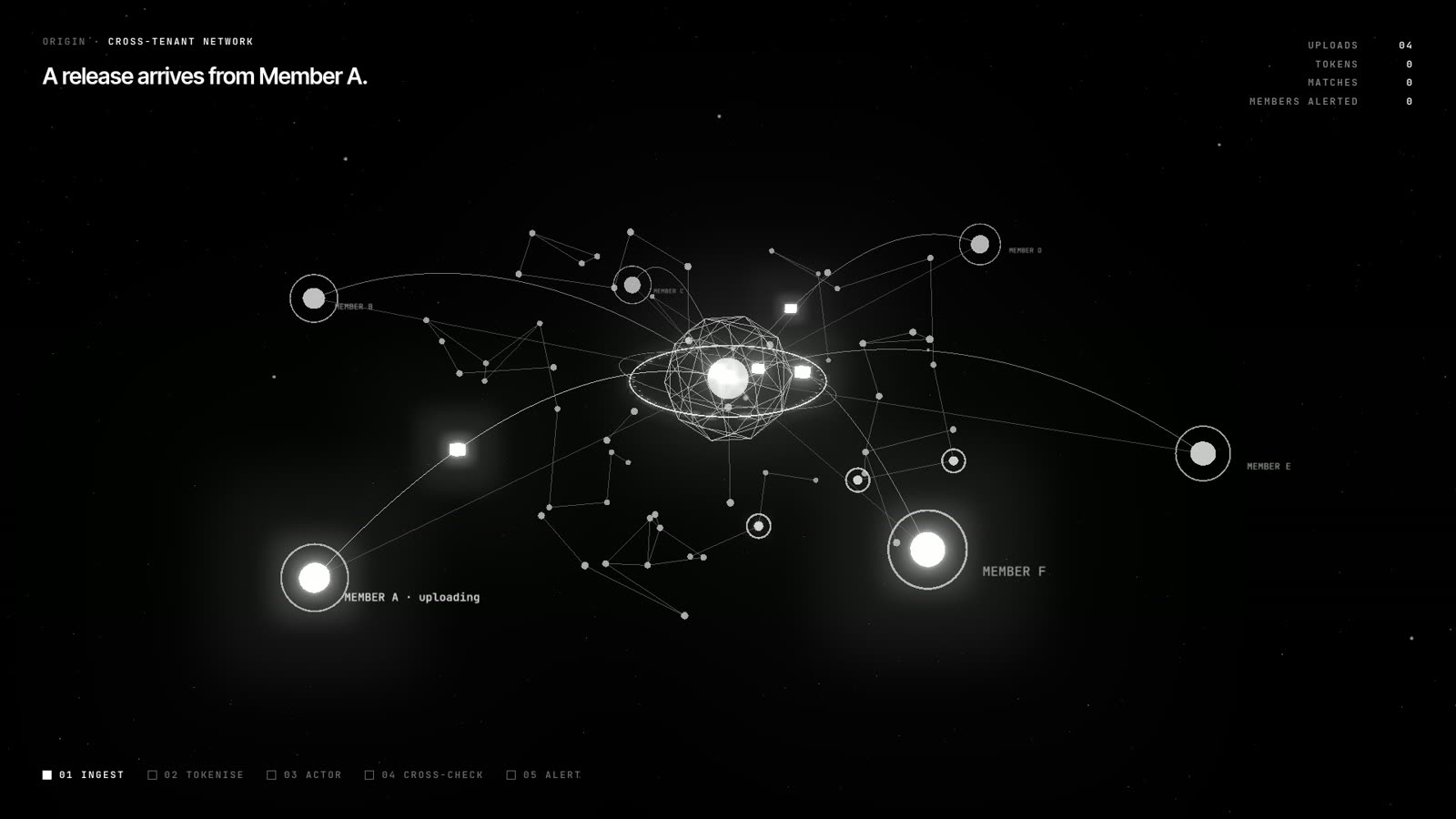
Cross-tenant network · one signal, every member

Every member sees the fraud. Nobody sees the data.

Processed without ever being seen. Not by other members. Not even by us.

The ring banned at one distributor opens an account at the next. The network flags it at the door, and no catalogue, identity or reporter ever crosses.

Cross-tenant network · ingest → tokenise → actor → cross-check → alert

Privacy stack · five layers, from input to answer
  1. L1 · At the sourceReadable data never leaves the member.Records become one-way tokens before anything travels.
  2. L2 · In useNobody can read the data while it’s checked.Not other members, not us. Checks run on inputs that stay sealed end to end.
  3. L3 · The modelFraudsters can’t study it. Members can’t copy it.It learns from the whole network without anyone handing over their data.
  4. L4 · ProofAnyone can check what ran.Every check is signed, so a result can be verified without trusting us.
  5. L5 · The answerA signal, never a record.The answer can’t be traced back to a record, or to who reported it.
What a screen returns
A risk band, an advisory score, how many other members flagged the actor, and the strongest signal tier. Network signals inform your policy; they never decide on their own.
The signal crosses. The catalogue never does.
Members see how many others flagged an actor, never who reported it or what was uploaded.
Founding cohort
Founding members are onboarding now, and set the network’s rules with us.

Why this approach

Detection tells you what it thinks. ORIGIN proves what you decided.

  • Deterministic

    Same input, same answer.

    The same upload under the same policy gets the same answer, every time. Models add signals; by default they never set the verdict.

  • Fail safe

    Held, never waved through.

    When a check can’t complete, the upload is held for review, never waved through.

  • Provider-agnostic

    Keep your detection stack

    Every external capability sits behind a swappable seam, and your own tools’ outputs can be passed straight in.

  • Verifiable

    Proof anyone can check

    Decisions are signed with a published key, with public revocation lists a DSP, an artist or a regulator can check themselves.

  • Private

    Private by construction

    Records become one-way tokens at the source and are checked sealed end to end, so no other member, and no one at XYNQ, reads them. Five privacy layers, from input to answer.

  • Auditable

    People stay on the record

    Every override lands in an append-only, hash-chained history, so a year later you can show who decided what, and why.

Policy

Deterministic by design. Yours to calibrate.

Every decision re-derives from its inputs and policy version, so it stands up a year later, in front of anyone who asks. Set the signals below and watch the evaluator decide.

  • Per-tenant policy.

    Thresholds are set per tenant, and every Evidence Pack records the policy version it was decided under.

  • Guardrails only escalate.

    A guardrail can raise a decision, never lower it. The one step down: a strong assurance score can promote a low-risk REVIEW to ALLOW, never a QUARANTINE or REJECT.

  • Innocent until corroborated.

    By default a new or unknown account isn’t penalised: a release clears unless a real signal escalates it.

  • Two layers of rules.

    Your private thresholds, annotated against the DSA, the EU AI Act and the UK Online Safety Act in the same call.

Try the evaluator

ORIGIN-CORE-v1.0 · default calibration
Policy mode
32
  • ALLOW* 0–39
  • REVIEW 40–69
  • QUARANTINE 70–89
  • REJECT 90–100

Thresholds are set per tenant. * Below 40 clears only if the clean-signal checks pass.

Risk is advisory by default: at 90 or above it can only move ALLOW to REVIEW. Thresholds are set per tenant.

Signals
ALLOW
    How the evaluator decides

    Simplified from the published evaluation order: baseline, guardrails that only escalate, the risk safety net, then assurance promotion (a low-risk REVIEW to ALLOW only; it never touches a QUARANTINE or REJECT, and never overrides a tenant-enabled content-integrity guardrail). Not every always-on guardrail is shown; the optional guardrails (ISRC recycling, declared-vs-detected AI, undeclared cover) and cross-tenant corroboration are off by default and not simulated.

    Team

    The team behind ORIGIN.

    Music, compliance, cryptography and regulated engineering in one founding team, with advisors from the platforms and institutions this has to work for.

    • Leo Fakhrul

      CryptioHeriot-Watt UniversityUniversity of Strathclyde

      CEO

      Label founder who lived the problem first-hand. Law and financial-compliance background: KYC, AML, audit.

    • Imtiyaz Miah

      University of CambridgeWintermute

      Head of Product

      Master’s in Computer Science, Cambridge. Cryptography and AI specialist. Built an exchange that has processed $25B in volume, and wrote the block builder behind 20% of Ethereum blocks.

    • Ziyad Alrasbi

      Publicis SapientHeriot-Watt University

      Founding Engineer

      Ships production code across regulated industries: energy, banking, fintech. Built audit and control systems at Publicis Sapient.

    Advisors

    • David Mogendorff

      TikTokYouTube

      Artist services at TikTok and YouTube.

    • Matthew Burrows

      UBSCredit Suisse

      Former MD, UBS. Former Global COO Compliance, Credit Suisse.

    • Cliff Fluet

      Lewis Silkin

      Partner, Lewis Silkin. Music and AI law.

    Recognition

    Award-winning, with research partners in Scotland and Cambridge.

    • Scottish EDGE
      Winner · £15,000 · Round 27 · June 2026 Scottish EDGE: Wild Card Winner

      Top of Scotland’s pre-trading businesses in the Wild Card category.

      Winners announcement (Scottish EDGE)
    • Build Like a Pro
      Winner · Manchester · January 2026 Build Like a Pro: Scale Stream

      Won the Scale Stream at Build Like a Pro, Manchester.

      Official site (Build Like a Pro)
    • Scottish Government
      Selected · San Francisco · 3–17 October 2026 Techscaler Silicon Valley

      The Scottish Government’s founder programme.

    • Research partners University of Strathclyde · University of Edinburgh · Heriot-Watt University · University of Aberdeen · Cambridge Frontier Technologies Lab
    • Supported by Techscaler · CodeBase · The Data Lab · Creative UK · Scottish Enterprise · Interface

    Next step

    Register interest.

    See what ORIGIN would catch in your catalogue. Investors and partners welcome too. Leave your email and we’ll reply.

    Opens your email app.

    We’ll only use your email to reply and follow up about ORIGIN. Privacy notice